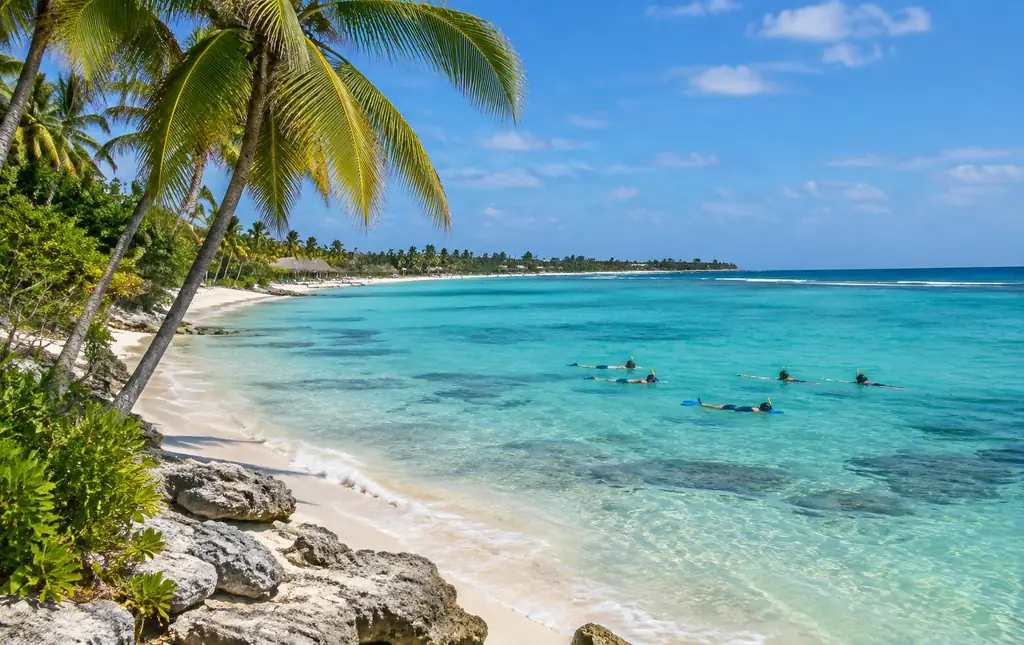
Akumal, Mexico: A Guide to the Bay of Sea Turtles
Facts checked October 2026
Akumal is a small beach town on Mexico's Caribbean coast, between Playa del Carmen and Tulum, famous for green sea turtles that feed in its shallow bay. The beach is public, but the main turtle area is protected and visited with a licensed guide. Arrive early, use reef-safe sunscreen and keep your distance from the turtles.
Where Is Akumal and What Is It Known For?
Akumal is in Quintana Roo, about 25 minutes north of Tulum and 40 minutes south of Playa del Carmen on Highway 307. Cancun airport is roughly 90 km away. The name means "place of the turtles" in Maya, and the town is known for Akumal Bay, its calm reef-protected water and resident sea turtles.
Akumal is not one beach but a string of small bays: Akumal Bay in the centre, Half Moon Bay and Yal-Ku Lagoon to the north, and Jade Bay and South Akumal to the south. It is a quiet town of villas and small resorts rather than a party place.
Why Do Sea Turtles Live in Akumal Bay?
Sea turtles live in Akumal Bay because it has a large seagrass meadow, the main food of the green sea turtle. The reef keeps the water calm and shallow, so the turtles graze close to shore all year. They rise every few minutes to breathe, which is when snorkelers see them best.
The beaches are also nesting sites. Loggerhead and green turtles lay eggs on Akumal's sand from about May to September, and the Centro Ecológico Akumal (CEA) counts and protects the nests each season. Marked nests on the beach should never be disturbed.
What Is Free and What Do You Pay For at Akumal Beach?
Access to Akumal beach is free, because all beaches in Mexico are public. You pay for extras: parking, the main gated entrance some visitors use, snorkel gear rental and a licensed guide for the protected turtle area. Treat anyone on the highway selling an "official beach ticket" with caution.
| Item | Free or paid | Note |
|---|---|---|
| Walking onto the beach | Free | Use a public access point |
| Swimming near the shore | Free | Inside the marked public area |
| Guided turtle area | Paid | Licensed guide required |
| Parking | Paid | Usually cash, by the day |
| Mask, fins, life vest | Paid | Rent or bring your own |
| Yal-Ku Lagoon | Paid | Separate park entry |
Can You Swim With Turtles in Akumal Without a Guide?
Only partly. You can snorkel on your own in the public area near the shore, and turtles sometimes come close. The main seagrass field, where most turtles feed, is a protected zone you enter only with a licensed guide. The CEA confirms that a guide is not required for the public swimming area itself.
A guide adds the best turtle area, a life vest and someone who reads the currents and flags. If you would rather have transport, guide and gear arranged in one booking, our Akumal turtle snorkeling trip with pickup covers it.
Which Rules Protect the Turtles in Akumal Bay?
The rules in Akumal Bay exist to keep the turtles feeding and the seagrass alive. Akumal Bay has been a protected fishing refuge since 2015, and the limits on visitors cut daily numbers sharply. Break a rule and guides or authorities can remove you from the water.
- Never touch, feed, chase or ride a turtle.
- Keep about three metres away and do not block its way up to breathe.
- Do not stand on the seagrass or the coral.
- Use only mineral, reef-safe sunscreen, or wear a rash guard instead.
- No flash photography or selfie sticks pushed toward the animals.
- Stay inside the buoy lines and follow the lifeguard flags.
What Is Yal-Ku Lagoon Like for Snorkeling?
Yal-Ku Lagoon is a rocky inlet at the north end of Akumal where fresh water from underground rivers meets the sea. The water is calm with no waves, which makes it good for beginners and children. Expect parrotfish, sergeant majors and sometimes rays, plus a sculpture garden on the shore.
- Open daily from 9 am to 5 pm, according to the park's official site.
- There are two entrances run by different operators, with different prices.
- Life vests are required at the main park entrance.
- Food, coolers, inflatables and pets are not allowed in.
- The water is clearest in the morning, before many swimmers stir up sand.
Which Other Beaches Are in Akumal?
Besides the main bay, Akumal has quieter beaches north and south. They suit walks, swimming and simple snorkeling away from the busiest area. Most are reached through residential roads, so look for public access paths and respect private property.
Half Moon Bay
Half Moon Bay is a curved, rocky bay between Akumal Bay and Yal-Ku. It has small reef patches close to shore and fewer people, but more rock and less sand. Water shoes help here.
Jade Bay and South Akumal
Jade Bay and South Akumal lie south of the main bay. They are calm, residential and often almost empty. Snorkeling is simpler than in the main bay, but turtles are seen less often.
How Do You Get to Akumal?
You reach Akumal from Highway 307, the coastal road between Cancun and Tulum. The turn is marked by the Akumal arch. Most visitors drive, take a colectivo van or an ADO bus to the highway stop, then walk about 10 minutes to the beach.
- From Tulum: about 25 minutes by car or colectivo north.
- From Playa del Carmen: about 40 minutes south by colectivo or car.
- From Cancun: about 1 hour 30 minutes; ADO buses stop at the highway.
- From Cozumel: ferry to Playa del Carmen, then south as above.
- By car: park at a paid lot near the arch and bring pesos.
When Is the Best Time to Visit Akumal?
The best time to visit Akumal is between 8 and 10 am on any day of the year. The water is clearest, the turtles are feeding and the crowds have not arrived. Turtles live in the bay all year, so there is no "turtle season" for snorkeling, only for nesting.
December to April brings dry weather and less seaweed. May to October is hotter, more humid and more likely to bring sargassum, but it is also nesting season. Akumal stays warm, around 24 to 32°C, all year.
How to Spend One Day in Akumal
One day in Akumal is enough for turtles, a lagoon swim and lunch. Start early in the main bay, move north to Yal-Ku, and finish with a slow afternoon on a quiet beach.
- Arrive by 8 am and snorkel the guided turtle area first.
- Rest on Akumal Bay beach while the crowds arrive.
- Drive or walk north to Yal-Ku Lagoon by late morning.
- Have lunch at a small restaurant in town.
- Spend the afternoon at Half Moon Bay or a nearby cenote.
What Should You Bring to Akumal?
Bring things that protect you and the reef. Akumal Bay has little shade near the water, and chemical sunscreen is not allowed in the protected zone.
- Mineral, reef-safe sunscreen and a rash guard.
- Your own mask and snorkel, if you have them.
- Water shoes for Half Moon Bay and Yal-Ku rocks.
- Mexican pesos in cash for parking and small shops.
- A dry bag for your phone and keys.
- Water and a light snack.
Is Akumal Safe for Visitors?
Akumal is generally considered safe for visitors. It is a small, quiet town with many long-stay foreign residents and little nightlife. The main risks are ordinary ones: sun, currents outside the reef, and petty theft from unattended bags on the beach.
Swim inside the buoys, check the lifeguard flags, and do not leave valuables on the sand. Follow your government's travel advice for Quintana Roo before the trip.
Day Trip or Stay: Is Akumal a Good Base?
Akumal works best as a day trip for most visitors, and as a calm base for families or couples who want quiet beaches. It has small restaurants and villas but few shops. From Akumal, the Tulum ruins and Coba are both easy morning trips.
If you base yourself here, plan a morning at the clifftop Maya city using our Tulum ruins visitor guide, about 25 minutes south.
Akumal FAQ
Can kids swim with the turtles in Akumal?+
Yes, if they are comfortable in the sea with a life vest. Akumal Bay is shallow and calm on most days, and the turtles graze in 2 to 4 metres of water. Many guides accept children from about 6 years old. Younger children can splash in the public swimming area near the shore.
Can you touch the turtles in Akumal?+
No. Touching, feeding, chasing or blocking a turtle in Akumal Bay is forbidden and can bring a fine. Keep a distance of about three metres and never swim above a turtle when it rises to breathe. Turtles that are stressed by people stop feeding and can leave the bay.
Is there sargassum in Akumal?+
Sometimes. Sargassum seaweed reaches the Akumal coast mostly between April and September, with big differences from week to week. The bay is partly sheltered by the reef and beach crews clean it often. Check a recent webcam or local report a day before your visit.
Are there cenotes near Akumal?+
Yes. Several jungle cenotes sit just inland from Akumal along Highway 307 and the road to Coba, and Yal-Ku Lagoon itself is fed by underground fresh water. Cenotes give calm, clear swimming on days when the sea is rough or full of seaweed.
Do you need cash in Akumal?+
Bring some. Parking, small restaurants, lockers and some local guides only take Mexican pesos in cash. There are few ATMs in Akumal itself, so take money out in Playa del Carmen or Tulum first. Larger restaurants and Yal-Ku's main entrance usually accept cards.
How crowded is Akumal Bay?+
Akumal Bay is busiest from about 10 am to 2 pm, when tour vans and day visitors arrive. Daily access to the guided turtle area is limited, so the water is calmer than before the rules. Arriving around 8 am gives the clearest water and the fewest people.
Planning more days on the coast? Browse our Riviera Maya day trips.
More Near Akumal
Akumal sits close to Casa Cenote and Cenote Dos Ojos. For other sand and swim spots, read our Tulum beach guide and the full list of things to do in Tulum.
Want gear, a guide and pickup? Book the Akumal turtle snorkeling tour.