Tulum Ruins: A Complete Guide to Mexico's Clifftop Mayan City
Facts checked October 2026
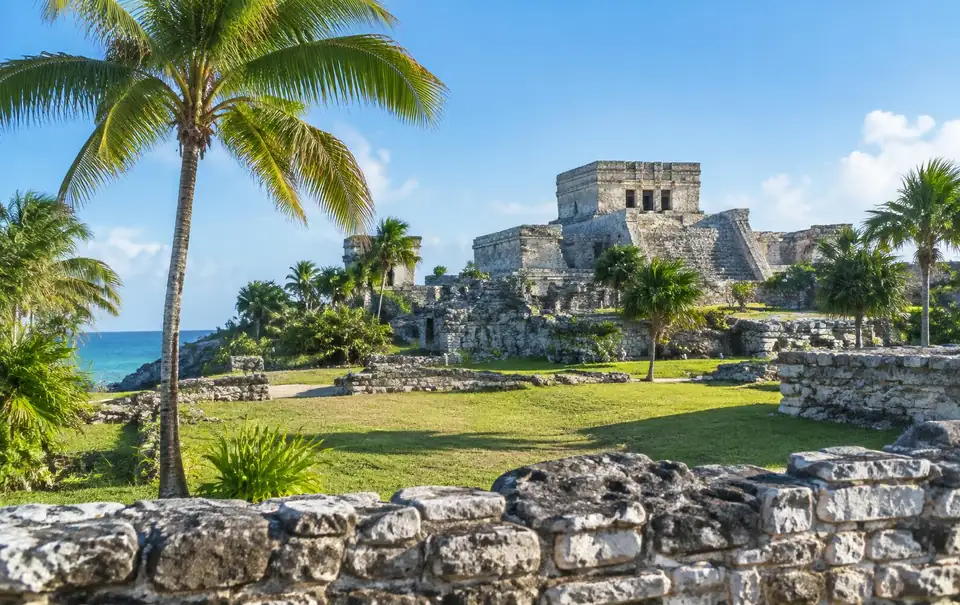
The Tulum ruins are the remains of a walled Maya port city on a limestone cliff above the Caribbean Sea, in Quintana Roo, Mexico. The city flourished between about 1200 and 1521 AD. Visitors can see El Castillo, the Temple of the Frescoes and a small beach. The site opens daily from 8 am, and foreign visitors pay MXN 265 in 2026.
What Are the Tulum Ruins?
The Tulum ruins are a Maya archaeological site and one of the few walled cities the Maya built on the coast. A stone wall closes three sides. The fourth side is a 12-metre cliff above the sea. Mexico's heritage institute, INAH, runs the site. Today it sits inside the protected Parque del Jaguar, next to Tulum National Park.
The site is small compared with inland cities like Coba or Chichen Itza. You can walk around the whole walled area in under an hour. What makes the Tulum archaeological site famous is its setting: grey temples, palm trees and turquoise water in one view.
Why Did the Maya Build Tulum on the Sea?
The Maya built Tulum on the sea because it was a trading port. Canoes carried goods along the Caribbean coast, and Tulum controlled a rare break in the reef with a landing beach. From there, trade went inland to cities such as Coba. The cliff and the wall also made the city easy to defend.
Zamá, the City of Dawn
The Maya likely called the city Zamá, meaning "dawn", because it faces the sunrise. "Tulum" means "wall" in Yucatec Maya and became the common name later. The oldest dated object found at the site is a stela from 564 AD, but most buildings you see today date from the Late Postclassic period, after 1200 AD.
A Trading Port Seen by the Spanish in 1518
In 1518 the Spanish expedition of Juan de Grijalva sailed past the coast and described a city as large as Seville. Archaeologists have found copper from central Mexico, jade from Guatemala and flint and pottery from Yucatan at the site, proof of a wide trade network.
Abandonment and Rediscovery
Tulum stayed inhabited for several decades after the Spanish arrived. Diseases from Europe killed much of the population, and by the late 1500s the city was empty. Explorers John Lloyd Stephens and Frederick Catherwood published drawings of Tulum in 1843, which made the ruins known outside Mexico.
What Can You See Inside the Tulum Archaeological Site?
Inside the Tulum archaeological site you can see dozens of stone structures. The highlights are El Castillo on the cliff, the Temple of the Frescoes with traces of painted murals, the Temple of the Descending God and the city wall with its narrow gates. A wooden staircase leads down to the beach.
El Castillo
El Castillo is the tallest building in Tulum and the one many people call the Tulum pyramid. It stands on the cliff edge and may have worked as a landmark for canoes. Two windows in the upper temple are thought to have guided boats through the gap in the reef.
Temple of the Frescoes
The Temple of the Frescoes is a two-level building near the main path. Inside are murals showing Maya gods and offerings, painted in the Postclassic style. Visitors cannot enter, but you can see the carved figures on the corners of the facade.
Temple of the Descending God
The Temple of the Descending God takes its name from a carved figure diving head-down over the doorway. Researchers still debate who the figure is; ideas include a bee god, the setting sun or the planet Venus. The same figure appears on other buildings in Tulum.
The City Wall and Smaller Buildings
The thick limestone wall runs along the land side of the city and is broken by five narrow gates. Inside are house platforms, small shrines and the House of the Columns, which may have been an elite home.
When Are the Tulum Ruins Open?
The Tulum ruins are open every day of the year, including Sundays and holidays, from 8:00 am to 5:00 pm. Ticket sales stop around 3:30 pm, and staff begin clearing the site before closing. Quintana Roo does not use daylight saving time, so these hours do not shift.
Hours are set by INAH and can change for events or weather. Check close to your visit, and plan to arrive near 8 am.
How Much Does It Cost to Enter the Tulum Ruins in 2026?
Since 20 July 2026, foreign visitors pay MXN 265 to reach and enter the Tulum ruins: MXN 100 for Parque del Jaguar plus a combined MXN 165 for Tulum National Park and the archaeological zone. Mexican nationals pay MXN 80 Monday to Saturday. Many older guides still show higher prices.
| Visitor | Total | Covers |
|---|---|---|
| Foreign visitor | MXN 265 | Parque del Jaguar, National Park, archaeological zone |
| Mexican national (Mon–Sat) | MXN 80 | National Park and archaeological zone; Jaguar Park free |
| Mexican nationals and residents (Sunday) | Free | All three charges |
Source: federal decree published in the Diario Oficial de la Federación, valid for 2026 and 2027. Parking, the in-park shuttle and guides cost extra.
How Do You Get to the Tulum Ruins?
The Tulum ruins are about 4 km north of Tulum town, off Highway 307. Playa del Carmen is about one hour away by car or ADO bus, and Cancun about two hours. All visitors now enter through Parque del Jaguar, then walk or take the park's electric shuttle to the ruins.
- From Tulum town: bike, taxi or colectivo van to the Parque del Jaguar entrance, in 10 to 15 minutes.
- From Playa del Carmen: ADO bus or colectivo south on Highway 307, then a short taxi.
- From Cancun: ADO bus to Tulum, or a rental car; leave early to beat the heat.
- From Cozumel: ferry to Playa del Carmen first, then as above.
- By car: use the official parking at the park; bring pesos.
How Long Do You Need at the Tulum Ruins?
Most visitors need 2 to 3 hours at the Tulum ruins in total. Walking the walled city takes about 1 to 1.5 hours. Add 20 to 30 minutes to get from the park entrance to the ruins and back, and up to an hour if you want time at the beach.
- Arrive at the Parque del Jaguar entrance by 8:00 am.
- Ride or walk to the ruins gate, about 10 to 15 minutes.
- See El Castillo and the cliff viewpoints first, before the crowds.
- Walk to the Temple of the Frescoes and the Descending God.
- Go down to the beach if it is open, then leave by late morning.
Can You Visit the Tulum Ruins Without a Guide?
Yes. You can visit the Tulum ruins on your own with a ticket from the gate, and the paths are easy to follow. Signs are short, though, so many independent visitors see the views but miss what each building meant. Licensed guides offer walks at the entrance.
Going alone suits people with a car or staying in Tulum town. If you are coming from Cancun, Playa or Cozumel and want transport and the story in one day, a guided Tulum ruins tour with hotel pickup removes the bus, ticket and timing planning.
Which Rules Apply Inside the Site?
The Tulum archaeological site has a short list of rules, all meant to protect the buildings. You cannot climb or touch the structures, and you must stay on the marked paths. Drones, tripods and commercial filming need an INAH permit.
- No climbing on El Castillo or any temple.
- No drones, tripods or professional filming without a permit.
- No food inside the walled area; water is fine.
- Use only biodegradable sunscreen if you swim.
- Do not feed the iguanas or other wildlife.
- Pets are not allowed.
Can You Swim at the Tulum Ruins Beach?
Often, yes. A wooden staircase leads from the cliff to a small beach below El Castillo, and swimming is usually allowed when the stairs are open. The beach can close for turtle nesting, heavy sargassum seaweed or rough sea. There are no changing rooms, so wear your swimsuit under your clothes.
The beach is small and busy by late morning. For a longer swim, a cenote nearby has calmer, clear fresh water; our Tulum ruins and cenote day trip pairs the two. To snorkel beside sea turtles, see our guide to Akumal's turtle bay, 25 minutes north.
When Is the Best Time of Day to Visit?
The best time to visit the Tulum ruins is right at 8 am opening. The air is cooler, the light is soft on El Castillo and the large tour buses and cruise groups usually arrive from about 10 am. Late afternoon is quieter too, but remember the 3:30 pm ticket cut-off.
By season, December to April is driest and busiest. May to October is hotter with afternoon rain and more seaweed on the beach, but fewer people.
What Should You Bring?
Bring sun protection, water and pesos. The Tulum ruins have very little shade, and card payment is not always possible for small extras like parking, the shuttle and snacks.
- A hat, sunglasses and biodegradable sunscreen.
- At least one litre of water per person.
- Mexican pesos in small notes.
- Comfortable shoes for sand and gravel.
- Swimsuit and a small towel if you want the beach.
- Insect repellent for the jungle walk from the park entrance.
Are the Tulum Ruins Worth It Compared With Coba and Chichen Itza?
The Tulum ruins are worth it for the setting, not the size. No other major Maya site sits on a Caribbean cliff. If you want big pyramids and jungle, Coba or Chichen Itza are bigger. Many visitors pair Tulum with Coba, which is about 45 minutes inland.
| Site | Best for | Climbing | From Playa del Carmen |
|---|---|---|---|
| Tulum | Sea views, beach, short visit | No | About 1 hour |
| Coba | Jungle, bikes, tall pyramid | Main pyramid, with rules | About 1 h 45 min |
| Chichen Itza | Famous pyramid, large site | No | About 2 h 30 min |
Curious about the jungle pyramid? Read our guide to visiting the Coba ruins, or see what a Coba day tour with pickup involves.
Tulum Ruins FAQ
Can you climb the Tulum ruins?+
No. Climbing the buildings at the Tulum ruins is not allowed. Visitors walk marked paths and see El Castillo and the temples from behind ropes. The rule protects soft limestone and old paint. If climbing a pyramid matters to you, Coba is the nearby site where the main pyramid has reopened with rules.
Can you fly a drone at the Tulum ruins?+
Not without a permit. Drones at Mexican archaeological sites need written permission from INAH, the national heritage institute, and staff stop unpermitted flights. Tripods and professional filming also need a permit. Phone and normal camera photos are fine.
Are the Tulum ruins good for kids?+
Yes, for most children. The Tulum ruins are small, mostly flat and full of iguanas that kids love. The hard parts are the sun and the walk from the park entrance. Bring water, hats and snacks, and visit early. Strollers work on the main paths but struggle on sand.
Are there restrooms and food at the Tulum ruins?+
Restrooms, snack stands and shops are near the entrance area, outside the walled city. Inside the archaeological zone there is no food and almost no shade. Eat before you go in and carry water. Bring pesos in small notes for the small extra costs.
Can cruise passengers from Cozumel visit the Tulum ruins?+
Yes. Cozumel cruise passengers take the ferry to Playa del Carmen, then drive about one hour south. The round trip with the visit takes most of a day, so check your all-aboard time first and leave a clear buffer for the ferry back.
Is the Tulum archaeological site wheelchair accessible?+
Partly. The main paths of the Tulum archaeological site are fairly flat, but they mix packed earth, gravel and sand, and the beach stairs are not accessible. A wheelchair user can see the main viewpoints with help. Visit early, when it is cooler and quieter.
Planning more of your trip? See all our Tulum trips.
More Tulum Planning
The ruins are one stop on our list of things to do in Tulum. The beach below the cliff is covered in our Tulum beach guide, and the best time to visit Tulum helps you beat crowds and heat.
Want a quieter Maya site? Try the Muyil ruins south of town. For a nearby swim, see Gran Cenote. Want a guide and pickup? Book the Tulum ruins tour.