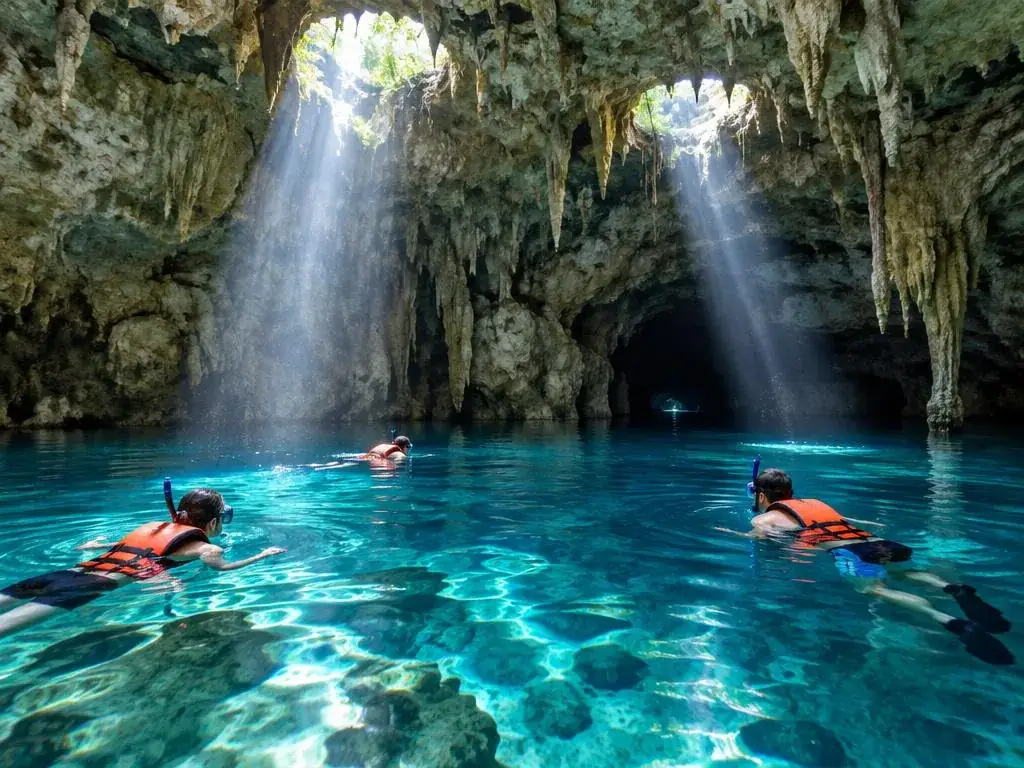
Cenote Dos Ojos, Tulum: How to Visit the "Two Eyes" Cenote
Prices checked October 2026 on the official park site · Illustrative image
Cenote Dos Ojos is a pair of connected cavern pools about 20 minutes north of Tulum, inside the community-run Parque Dos Ojos. Its name means "two eyes" because the two sinkholes look like eyes from above. Visitors snorkel through clear, cool water under stalactites, usually on a guided park tour that cost about 640 MXN in 2026.
This guide covers what the price includes, how to get there from Tulum, the Bat Cave, diving, rules and what to pack. Comparing cenotes? See the best cenotes in Tulum. Planning a wider trip? Start with our guide to things to do in Tulum.
| Quick facts | Cenote Dos Ojos (2026) |
|---|---|
| Location | Parque Dos Ojos, off Highway 307, near Xel-Há |
| From Tulum | About 20 km north, 20–25 minutes by car |
| Price | Guided snorkel tour ~640 MXN (official site, Oct 2026) |
| Hours | About 8:00 am–5:00 pm; tour slots morning, midday, afternoon |
| Water | Around 24–25 °C (75–77 °F), very clear |
| Best for | Snorkelers and certified cavern divers |
What Is Cenote Dos Ojos and Why Is It Famous?
Cenote Dos Ojos is a flooded limestone cavern on the Riviera Maya coast, known for very clear water, light beams and long underwater passages. Cenote Dos Ojos is famous because it is one of the most visited cavern snorkel and dive sites in Mexico, and the entry point to a huge cave system.
Why It Is Called the "Two Eyes" Cenote
The two openings, often called the first eye and the second eye, sit about 400 meters apart and are linked by a flooded passage. Seen from the air, the round pools look like a pair of eyes, which gives the site its Spanish name.
Part of One of the Longest Underwater Cave Systems
Sistema Dos Ojos was mapped by cave divers from the 1980s onward. In 2018, explorers linked it to Sac Actun, creating one of the longest known flooded cave systems, with more than 300 km of surveyed passages. Snorkelers only see a small, safe part near the surface.
Is Cenote Dos Ojos Right for You?
Cenote Dos Ojos suits confident swimmers, families with older children and anyone who wants a cave-style cenote. Cenote Dos Ojos is less ideal for people who dislike dark or enclosed spaces, because part of the swim passes through dim cavern sections.
- Non-swimmers: possible with a life jacket and a guide, but stay near the platforms.
- Children: usually fine with a vest; very young kids may find the cool water and dark areas scary.
- Limited mobility: expect wooden stairs and uneven paths down to the water.
- Claustrophobia: the first eye is open and bright; you can skip the darker passage.
- Divers: open-water certified divers can join guided cavern dives (see the diving section).
Cenote Dos Ojos Price and Tickets (2026)
The official Parque Dos Ojos website listed the guided Dos Ojos tour at about 640 MXN per person in October 2026. A combo ticket of about 960 MXN added the nearby Nicte-Ha and Jaguar cenotes. Prices change often, so treat these as a guide and confirm before you go.
| Ticket type | Approx. price | Source / date |
|---|---|---|
| Guided Dos Ojos tour | ~640 MXN (~US$35) | Official park site, Oct 2026 |
| Combo with Nicte-Ha + Jaguar | ~960 MXN | Official park site, Oct 2026 |
| Older entry-only price | 350 MXN | Travel blog, updated Feb 2024 |
| Older guided tour price | 700 MXN | Travel blog, updated Feb 2024 |
| Cavern dives (2 tanks) | From ~US$150–250 | Dive shops; varies by operator |
Guided Snorkel Tour vs Going on Your Own
Most visitors now see Cenote Dos Ojos on the park's own guided tour, booked at the gate or online. Older guides mention a cheaper entry-only option, but the 2026 official site mainly sells timed guided tours. You do not need an outside tour company; you can drive, take a taxi or a colectivo and buy the park ticket yourself.
What the Ticket Includes
According to the official park site and recent guides, the guided Dos Ojos tour typically includes:
- Entry to Parque Dos Ojos and the cenote.
- A local guide for the snorkel route.
- Life jacket, snorkel mask and often a wetsuit.
- Flashlight for the darker passage and, on many tours, access to the Bat Cave.
- Transport inside the park from the ticket area to the cenote.
Lockers and extra gear may cost more. Bring cash in pesos as a backup.
How to Get to Cenote Dos Ojos from Tulum
Cenote Dos Ojos is about 20 km north of Tulum town on Highway 307, just past the Xel-Há park. The trip takes about 20–25 minutes by car or taxi. From the highway, a park road leads into the jungle to the ticket area and then on to the cenote.
By Car
- Drive north from Tulum on Highway 307 toward Playa del Carmen.
- Pass the Xel-Há entrance and look for the Parque Dos Ojos sign on the inland side.
- Use the next U-turn (retorno) if you overshoot; there is a central barrier.
- Follow the park road to the ticket office and parking.
- Pay, then follow staff directions to the cenote area.
By Colectivo or Taxi
White colectivo vans run along Highway 307 between Tulum and Playa del Carmen. Ask the driver for "Dos Ojos" and get off at the park entrance; the fare is usually a few dozen pesos. A taxi from Tulum town is faster; agree the price before you get in and arrange the return, as taxis rarely wait at the park.
From the Park Entrance to the Cenote
The access road from the highway to the cenote is several kilometers long. Walking it in the heat is not practical for most people. Guided tours include park transport, and drivers can usually continue to the cenote parking after paying.
Cenote Dos Ojos sits on the same coast road as Akumal, so you can pair the two in one day. Our Akumal travel guide covers the turtle bay a few minutes away.
Cenote Dos Ojos Hours, Best Time and How Long to Spend
Cenote Dos Ojos is generally open daily from about 8:00 am to 5:00 pm. The official site sells tours in three time slots: morning (8–11 am), midday (11 am–2 pm) and afternoon (2–5 pm). Plan 2 to 3 hours in total, including the park transfer, briefing and swim.
- Best light: late morning, when sun beams shine straight into the water.
- Fewest people: the first slot after opening, before tour buses arrive.
- Busy times: late morning to early afternoon, weekends and Mexican holidays.
- Season: cenote water stays cool year-round, so it works even in rainy months.
Snorkeling at Cenote Dos Ojos and the Bat Cave
Snorkeling at Cenote Dos Ojos means floating on the surface of a clear cavern pool while you look down at rock formations, small fish and light beams. Cenote Dos Ojos snorkel tours follow a guide along rope lines, from the bright open areas into darker sections lit by flashlights.
The Two Openings: Cavern Light and Dark Passages
The first eye is the larger, brighter pool with a wide open area and platforms. The second eye is darker, with more stalactites and a deeper feel. Small freshwater fish and, now and then, eels live in the cenote. The water is so clear that you may see divers' lights far below you.
The Bat Cave
The Bat Cave (Cueva de Murciélagos) is a dark chamber reached by swimming through a short passage from one of the openings. Bats roost on the ceiling above an air pocket. Guides keep groups quiet and use flashlights, and many recent tours include the Bat Cave in the price. Ask at the gate if it is open on your day.
Diving Cenote Dos Ojos: What Certified Divers Should Know
Diving Cenote Dos Ojos is a cavern dive, which means you stay within reach of daylight under a rock ceiling. Open-water certified divers can usually join with a licensed local dive guide. Cave diving deeper into the system needs full cave training.
- Two classic routes are the Barbie Line and the Bat Cave Line, each about 45 minutes.
- Typical depth is around 10 meters (33 feet), with good buoyancy control essential.
- The park requires divers to go with an authorized dive center; you cannot dive alone.
- Many dive shops combine Dos Ojos with The Pit, a deeper cenote in the same park.
Cenote Dos Ojos Rules and Safety Tips
Cenote Dos Ojos rules protect both visitors and the fragile water. The main rules are to shower before swimming, use no sunscreen or repellent, stay with your guide and keep to marked lines. Serious accidents have involved untrained or unguided cave diving, not normal surface snorkeling.
- Shower first and skip sunscreen, lotion and makeup, even "biodegradable" ones.
- Wear the life jacket if staff ask, especially in the dark passages.
- Never swim into cave openings beyond the guided route.
- Do not touch or stand on stalactites and rock formations.
- Keep voices low in the Bat Cave to avoid disturbing bats.
- Divers: only dive with a certified cenote guide and follow the briefing.
What to Bring to Cenote Dos Ojos
For Cenote Dos Ojos, bring swimwear under your clothes, a towel, cash in pesos and water. Gear such as masks, life jackets and wetsuits can be rented or are included in the tour, but your own mask often fits better.
- Swimsuit worn under clothes to save time.
- Quick-dry towel and a change of clothes.
- Pesos in cash for lockers, extras and tips.
- Your own mask and snorkel, if you have them.
- Water shoes for slippery steps.
- Waterproof phone case or action camera on a strap.
- Bug spray for after your swim, on the jungle paths only.
Other Cenotes Inside Parque Dos Ojos
Parque Dos Ojos includes several other cenotes on the same community land, run by the local ejido. These Parque Dos Ojos cenotes can be added with combo tickets and are often quieter than the main site.
| Cenote | Type | Good for |
|---|---|---|
| Nicte-Ha | Open, with water lilies | Calm family swim |
| Jaguar | Open with jump platforms and a zipline | Active swimmers |
| El Pit | Deep vertical shaft | Advanced divers |
| Monos | Small open cenote | Short swim (check if open) |
| Misterio Maya | Cave cenote, guided | Cave tour fans |
Dos Ojos or Gran Cenote: Which Should You Choose?
Choose Dos Ojos for a deeper cave feel, guided dark passages and the Bat Cave. Choose Gran Cenote if you want a shorter trip from Tulum town, sunny open pools and a chance to see turtles. Both are clear and cool; Dos Ojos feels more like an adventure.
| Cenote Dos Ojos | Gran Cenote | |
|---|---|---|
| Distance from Tulum | ~20 km, 20–25 min | ~4 km, 10 min |
| Feel | Cavern, darker passages | Open pools + short cavern |
| Visit style | Mostly guided park tour | Pay at gate, swim freely |
| Highlights | Bat Cave, light beams, diving | Turtles, boardwalk |
See our full Gran Cenote visitor guide for its prices and hours. Note that our Tulum ruins and Gran Cenote tour visits Gran Cenote, not Dos Ojos; it is an easy option if you want the ruins and a cenote in one morning with pickup.
Cenote Dos Ojos FAQ
How deep is Cenote Dos Ojos?+
The snorkel area at Cenote Dos Ojos is mostly about 5 to 10 meters (16 to 33 feet) deep. The cave system goes far deeper in places: The Pit, a cenote inside the same park, drops to around 119 meters according to cave survey records. Snorkelers stay at the surface.
When was Cenote Dos Ojos discovered?+
Local Maya communities have always known the Dos Ojos cenotes. Cave divers began mapping the underwater passages in the mid-1980s. In 2018, explorers confirmed that Sistema Dos Ojos connects to the Sac Actun system, which is one of the longest underwater cave systems known.
Can you swim at Dos Ojos without a life jacket?+
Life jackets are normally required for snorkelers on the guided Dos Ojos tour, and staff may ask non-swimmers to keep them on. Rules can change by season, so ask at the gate. A life jacket also helps you float calmly in the darker cavern sections.
Is Cenote Dos Ojos worth it?+
Cenote Dos Ojos is worth it if you want a true cave experience with clear water, stalactites and a guided swim into darker passages. If you only want a quick, sunny swim close to Tulum town, a smaller open cenote may suit you better and cost less.
Visiting in the wet season? Check our Tulum weather by month guide, then explore the beaches in Tulum after your swim.
More Cenotes Near Tulum
Compare Dos Ojos with Gran Cenote and Casa Cenote, or see every option in the best cenotes in Tulum. Akumal is a short drive away.
Our Tulum ruins and cenote tour visits Gran Cenote, not Dos Ojos.