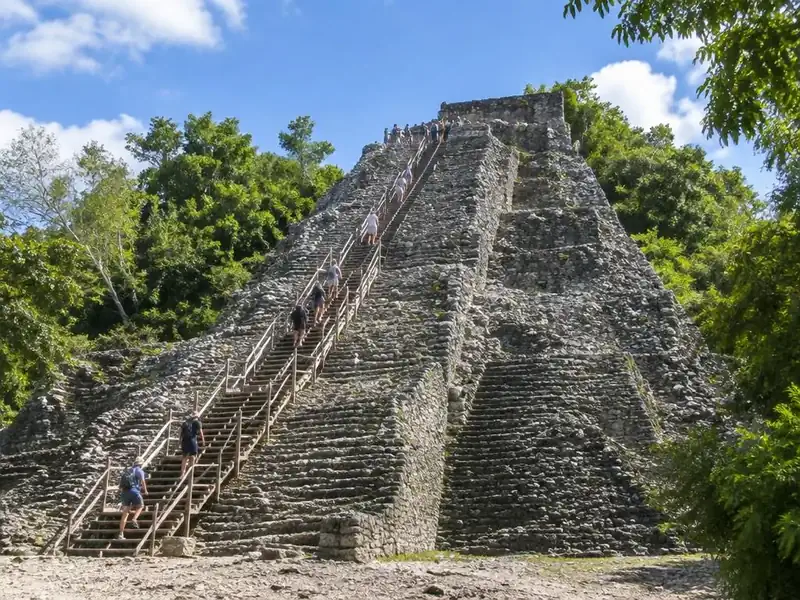
Coba Ruins: How to Visit and Climb Nohoch Mul (2026 Guide)
Fees and hours checked October 2026 on the official INAH site · Illustrative image
The Coba ruins are a large Maya city in the jungle about 45 km (45 minutes) inland from Tulum. The Coba site is famous for Nohoch Mul, a 42-meter pyramid that visitors can climb again since 8 December 2025. Entry costs 210 MXN at the INAH gate plus a separate community fee, and most people spend three to four hours there.
This guide covers climbing rules, fees, hours, getting there from Tulum, bikes, what to see and how Coba compares with the coastal ruins. For more day ideas, see our list of things to do in Tulum.
Coba Ruins at a Glance: Quick Facts
Coba (Cobá) is an archaeological zone run by INAH, Mexico's national institute of anthropology and history. The quick facts below cover what most visitors ask before a trip. All prices are in Mexican pesos (MXN).
| Quick facts | Coba ruins (2026) |
|---|---|
| Location | Coba village, Quintana Roo, about 45 km northwest of Tulum |
| Can you climb? | Yes, Nohoch Mul reopened 8 Dec 2025 (with rules) |
| Entrance fee | 210 MXN INAH (105 MXN Mexican nationals/residents) + community fee |
| Hours | 8:00 am–5:00 pm daily, last entry 4:00 pm |
| Climb hours | 8:00 am–3:30 pm |
| Time needed | 3–4 hours on site |
| Getting around | Walk, rent a bike or hire a tricycle taxi |
Can You Climb the Coba Pyramid in 2026?
Yes, you can climb the Coba pyramid in 2026. INAH reopened Nohoch Mul to climbers on 8 December 2025 after it had been closed since 2020. Climbers now use a new wooden staircase with a handrail built over the old stone steps, so the ancient stones are protected. Many older websites still say the climb is banned, which is out of date.
Nohoch Mul ("big mound" in Yucatec Maya) is about 42 meters (138 feet) tall, with around 120 steps. It is the tallest pyramid in the northern Yucatán Peninsula. From the top platform you see unbroken jungle and the Coba lagoons.
Nohoch Mul Climbing Rules and Cut-Off Time
The official INAH page (updated February 2026) lists these rules for the Nohoch Mul climb:
- Climb hours: 8:00 am to 3:30 pm, earlier than the site's 5:00 pm closing.
- Group size: up to 15 people on the staircase at a time.
- Time at the top: up to 15 minutes.
- Weather: staff may pause climbing in rain or storms.
- Footwear: closed shoes with grip are strongly advised.
At busy times you may queue for your group. Arriving early keeps the wait short.
Is the Coba Climb Hard or Scary?
The Nohoch Mul climb is steep but short, usually 10 to 15 minutes up for a person of average fitness. The handrail makes it much easier than the old rope climb. Coming down feels steeper, so many people descend slowly, facing the steps. If heights worry you, climb a few levels and turn back.
Coba Ruins Entrance Fee: What You Pay and Why You Need Cash
The Coba ruins entrance fee in 2026 is 210 MXN per foreign adult at the INAH ticket booth, according to the official INAH website. Mexican nationals and residents pay 105 MXN. A separate community (ejido) fee of about 120 MXN is collected near the entrance, so a foreign adult pays roughly 330 MXN in total.
| Cost at Coba | Amount (2026) | Source |
|---|---|---|
| INAH entry, foreign visitor | 210 MXN | Official INAH site, Feb 2026 |
| INAH entry, Mexican/resident | 105 MXN | Official INAH site, Feb 2026 |
| Community (ejido) fee | About 120 MXN | Recent 2026 guides; confirm at gate |
| Parking | Small extra fee | Varies; bring pesos |
| Bike rental / tricycle | Extra, paid on site | Varies; ask before you ride |
INAH raised fees across Quintana Roo in January 2026, so guides showing 80 or 95 MXN are old. The Coba village has limited card reception and no reliable ATM, so bring enough cash in pesos for both fees, parking and a bike.
Coba Ruins Hours and the Best Time to Arrive
The Coba ruins are open every day from 8:00 am to 5:00 pm, with last entry at 4:00 pm. The best time to arrive is 8:00 am, before tour buses come at around 10:00 am. An early start means cooler air for the walk, a shorter queue for the climb and softer light for photos.
If you arrive after 2:00 pm, you may not reach Nohoch Mul before the 3:30 pm climb cut-off. For the season, December to April is drier; summer brings heat and afternoon rain. See Tulum weather month by month before choosing dates.
How to Get to Coba Ruins from Tulum
The Coba ruins are about 45 km from Tulum along Highway 109, a straight road through the jungle. The drive takes around 45 minutes. You can drive yourself, take a bus or colectivo, use a taxi, or join an organized trip with transport.
| Option | Time from Tulum | Good to know |
|---|---|---|
| Rental car | About 45 min | Most flexible; watch speed bumps (topes) |
| ADO bus | About 1 hour | Few departures a day; check return times |
| Colectivo | About 1 hour | Cheap; leaves when full |
| Taxi | About 45 min | Agree a round-trip price first |
Driving and Parking at Coba
- Leave Tulum on Highway 109 toward Coba and Valladolid.
- Drive about 40 km and slow down for village speed bumps.
- Turn right at the Coba junction toward Coba village.
- Follow the lagoon road to the ruins parking lot.
- Pay the parking fee in cash and walk to the ticket booth.
Colectivo, Bus or Taxi from Tulum to Coba
ADO buses leave from Tulum's main bus station and stop in Coba village, a short walk from the ruins. Colectivos leave from Tulum town and are cheaper but less predictable. Taxis are quickest without a car; agree the full price, including waiting time, before leaving.
Getting to Coba from Playa del Carmen or Cancun
From Playa del Carmen, the Coba ruins are about 1 hour 30 minutes away by car via Tulum. From Cancun, plan on about 2 to 2 hours 30 minutes. Most visitors from these areas combine Coba with a stop in Tulum.
Getting Around the Coba Ruins: Walk, Bike or Tricycle Taxi
The Coba ruins are spread over several kilometers of jungle paths, so getting around is part of the plan. A round trip from the entrance to Nohoch Mul and back is about 5 to 6 km. Most visitors walk, rent a bike or hire a tricycle taxi from the rental stand just past the entrance.
- Walking: free and shaded, but slow in the heat; allow extra time.
- Bike rental: flat paths make cycling easy and fun; bikes are parked at each group.
- Tricycle taxi (bicitaxi): a local driver pedals you; great for kids, older travelers or anyone saving energy for the climb.
- Mixed plan: some walk the Coba Group near the entrance, then rent a bike for the longer stretch.
What to See at the Coba Ruins
The Coba ruins hold several building groups linked by sacbe roads. The four highlights are the Coba Group, the Nohoch Mul Group, the Las Pinturas and Macanxoc areas, and the carved stelae. Only a small part of the ancient city is cleared; much of it still lies under jungle.
Coba Group and the Ball Court
The Coba Group is the first cluster near the entrance. It includes La Iglesia, a tall temple pyramid, and a well-kept Maya ball court with stone rings on its sloping walls.
Nohoch Mul Group
The Nohoch Mul Group sits about 2 km from the entrance. Besides the big pyramid, look for Stela 20 under a small roof at its base, one of the best-kept carved stones at the site.
Las Pinturas, Macanxoc and the Stelae
Las Pinturas takes its name from faded paint on a small temple. The Macanxoc Group holds several stelae carved with rulers and dates. The stelae at Coba record royal history from around the 7th century AD.
The Sacbe Roads and a Short History of Coba
Coba was a major Maya city from about 600 to 900 AD, with tens of thousands of residents. It built a network of raised white roads called sacbeob. One sacbe runs about 100 km west to Yaxuná, one of the longest in the Maya world. Coba later traded with coastal cities such as Tulum.
How Long to Spend at Coba (Sample Route)
Most visitors spend three to four hours at the Coba ruins. That is enough to see the main groups, climb Nohoch Mul and rest in the shade. Add an hour for a cenote swim nearby. A one-way trip from Tulum adds about 45 minutes each way.
- Arrive at 8:00 am, pay both fees and rent a bike.
- Walk the Coba Group and ball court near the entrance (30 min).
- Ride to the Nohoch Mul Group and see Stela 20.
- Climb Nohoch Mul before the crowds (30–45 min with queue).
- Ride back via Macanxoc and the stelae (45 min).
- Finish with lunch in Coba village or a cenote swim.
What to Bring to the Coba Ruins
Bring cash, water and good shoes to the Coba ruins. The jungle is humid, the paths are long, and the Nohoch Mul staircase is steep. Food and water are sold at the entrance but not deep inside the site.
- Cash in pesos for both fees, parking and bike rental.
- At least 1 liter of water per person.
- Closed shoes or trainers with grip for the climb.
- Insect repellent, hat and sunscreen.
- Swimsuit and towel if you plan a cenote swim.
Coba vs Tulum Ruins: Which Should You Visit?
Choose the Coba ruins for jungle, bikes and a pyramid you can climb. Choose the Tulum ruins for clifftop temples over the Caribbean and a short visit. The two sites feel very different, so many travelers see both, often on the same day.
| Feature | Coba ruins | Tulum ruins |
|---|---|---|
| Setting | Jungle and lagoons | Cliff above the sea |
| Climbing | Yes, Nohoch Mul (with rules) | No climbing |
| Size | Large, several km of paths | Small walled site |
| Time needed | 3–4 hours | 1–2 hours |
| Distance from Tulum town | About 45 min | About 10 min |
| Best for | Adventure, families, bikes | Photos, beach, short trips |
For full details on the coastal site, read our Tulum ruins visitor guide.
Cenotes Near Coba for a Swim After
Three cenotes near Coba make a cool swim after the ruins: Choo-Ha, Tamcach-Ha and Multun-Ha. All three are underground cave cenotes about 10 minutes from the site, reached by stairs. Each charges its own small entry fee in cash, and life jackets are usually available.
Prefer an open cenote closer to town? The Gran Cenote near Tulum is on the way back.
Visit Coba on Your Own or with a Tour?
Visit Coba on your own if you have a car and like a flexible day. A tour makes more sense if you do not want to drive, if you are staying far away, or if you want a guide to explain the site. Both ways let you climb Nohoch Mul.
If you would rather not plan transport, our Coba ruins tour with hotel pickup covers the drive, fees and a cenote swim.
Coba Ruins FAQ
Are there mosquitoes at Coba?
+
Yes. The Coba ruins sit in thick jungle beside two lagoons, so mosquitoes are common, especially in the rainy months from June to October and late in the day. Put on insect repellent before you enter, and choose a reef-safe one if you plan to swim in a cenote afterwards.
Is Coba good for kids?
+
Coba is one of the most child-friendly Maya sites near Tulum. Shady paths, bike rides and tricycle taxis keep children moving, and there is a lot of space to explore. Small children may not manage the steep Nohoch Mul staircase, so one adult can wait below while others climb.
What happens at Coba if it rains?
+
The Coba ruins stay open in light rain, and the jungle canopy gives some shelter. Staff can pause the Nohoch Mul climb when the wooden steps get wet or a storm is close, so the climb is never guaranteed. Showers in this region usually pass within an hour, so waiting often works.
Can you see Coba and the Tulum ruins in one day?
+
Yes. Coba and the Tulum ruins are about 45 minutes apart by car. Visit the Tulum ruins first thing at 8:00 am, then drive to Coba before midday, which still leaves time to climb before the 3:30 pm cut-off. The day is long and hot, so bring plenty of water.
Can you hire a guide at the Coba entrance?
+
Licensed local guides usually wait near the Coba entrance and offer walking tours of about 1.5 to 2 hours. Agree the price, language and route before you start. A guide explains the stelae and sacbe roads that are easy to miss, which adds a lot to a first visit.
Staying a few days? Read the best areas to stay in Tulum and our honest Tulum safety guide.
More Ruins Near Tulum
Compare Coba with the seaside Tulum ruins and the quiet Muyil ruins, and see more day ideas in things to do in Tulum. After the climb, the best cenotes in Tulum are a good way to cool off.
Want transport and a guide? Book the Coba ruins tour.