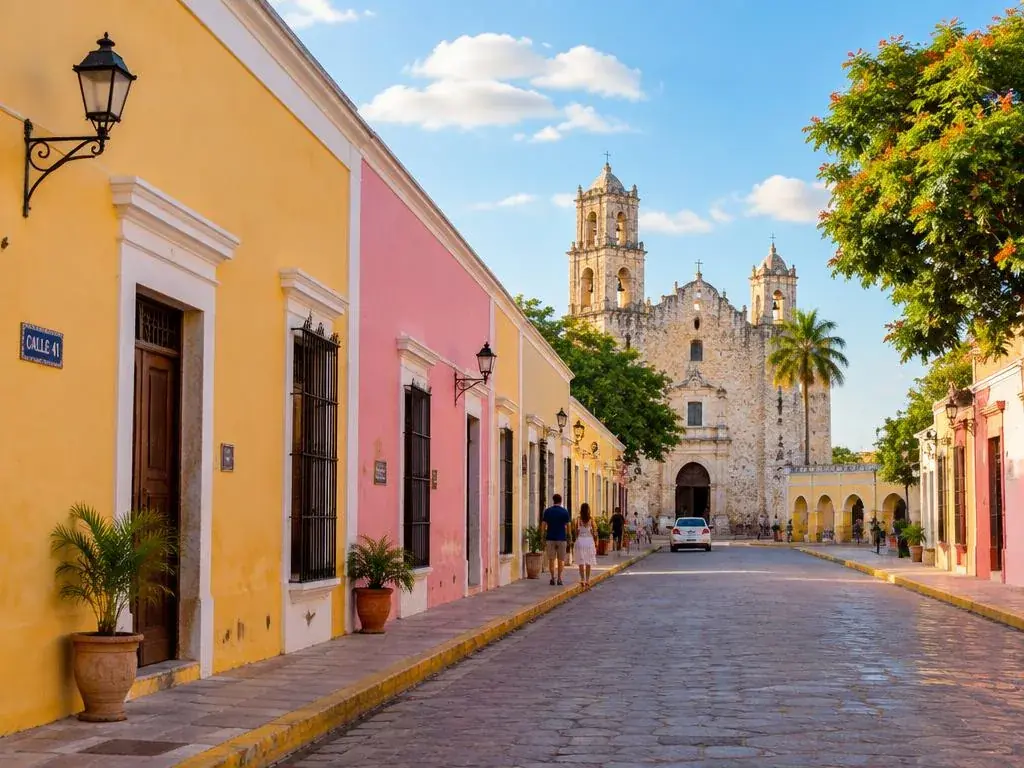
Valladolid, Mexico: A Visitor's Guide to Yucatan's Colourful Town
Facts checked October 2026
Valladolid is a colonial town in eastern Yucatan, about 2 hours from Cancun and 1 hour 45 minutes from Tulum. It is known for pastel streets, a 16th-century convent, a cenote right in town and its closeness to Chichen Itza. Plan one or two nights to see it without rushing.
Where Is Valladolid and What Is It Known For?
Valladolid is in the state of Yucatan, on the main highway between Cancun and Merida. Chichen Itza is about 45 km west and Ek Balam about 30 km north. It is the third-largest city in Yucatan but feels like a small town, with most sights within walking distance of the main square.
It was named a Pueblo Mágico ("Magical Town") by Mexico's tourism ministry in 2012. Visitors know it for colourful colonial houses, the Convent of San Bernardino de Siena, Cenote Zací in the centre, Yucatecan food and a slower pace than the beach towns.
What Are the Best Things to Do in Valladolid?
The best things to do in Valladolid are walking the colonial centre, swimming in a cenote, and watching the evening light show at the convent. Most sights are free or cost a small fee, and you can see the centre in one relaxed day.
Walk the Calzada de los Frailes
The Calzada de los Frailes is a cobbled street of painted houses, boutiques and cafés linking the centre to the convent. It is the most photographed street in town and is best in early morning, before the heat and the crowds.
Visit the Convent of San Bernardino de Siena
This Franciscan convent was built in the 1550s and 1560s and is one of the oldest in Yucatan. In the evening, a free video-mapping show projects the town's history onto its walls; check the start time locally, as it changes with the season.
See the main square and San Servacio church
The Parque Francisco Cantón is the heart of town, with the twin-towered San Servacio church on one side. Locals sell marquesitas and ice cream here at night, and traditional dancers often perform on weekend evenings.
Explore Casa de los Venados
Casa de los Venados is a private colonial home holding a large collection of Mexican folk art. Guided visits run most mornings, with a suggested donation that goes to local charity.
Shop at the Mercado Municipal
The municipal market is where residents buy fruit, meat and flowers. Go before noon for cheap breakfast stalls and a real look at daily life.
Which Cenotes Are Near Valladolid?
Valladolid has more easy-to-reach cenotes than almost any town in Yucatan. One is in the centre, and several more lie within 15 to 30 minutes by car, taxi or bike. Entry fees are small and change often, so carry pesos and check prices at the gate.
- Cenote Zací: a large semi-open cenote a few blocks from the main square. The easiest swim in town.
- Cenote Suytun: a cave cenote with a stone platform lit by a beam of sunlight around midday. Very popular for photos.
- Cenote Oxman: an open cenote inside an old hacienda, with a rope swing and a pool area.
- Xkeken and Samula (Dzitnup): two cave cenotes side by side, about 10 minutes from town.
- Cenote Saamal: a deep open cenote with hanging roots, near the road to Chichen Itza.
Rinse off sunscreen before swimming. Most cenotes require a shower first and a life vest for weaker swimmers.
How Do You Get to Valladolid?
You get to Valladolid by car, ADO bus or an organised day trip. The toll highway 180D connects it to Cancun and Merida, and free roads link it to Tulum and Coba. ADO buses run several times a day from Cancun, Playa del Carmen, Tulum and Merida.
| From | Distance | By car |
|---|---|---|
| Cancun | ~160 km | ~2 h |
| Playa del Carmen | ~180 km | ~2 h |
| Tulum | ~100 km | ~1 h 45 min |
| Coba | ~60 km | ~1 h |
| Merida | ~160 km | ~2 h |
| Chichen Itza | ~45 km | ~40 min |
Times are approximate and depend on traffic and stops.
How Many Days Do You Need in Valladolid?
Two days is ideal for Valladolid: one for the town and its cenotes, and one for Chichen Itza or Ek Balam. A single day trip works but feels rushed, because the drive from the coast takes about 4 hours return.
One-day plan
- Morning swim at Suytun or Xkeken before the tour buses.
- Late-morning walk down the Calzada de los Frailes to the convent.
- Lunch of lomitos or longaniza near the main square.
- Afternoon swim at Cenote Zací.
- Evening light show at the convent and dinner in the centre.
Two-day plan
Add Chichen Itza at opening time on day two, when it is coolest and calmest, then Cenote Saamal or Ik Kil on the way back.
What Day Trips Can You Take From Valladolid?
Valladolid is the closest town to several of Yucatan's top sites. Leaving early from here means you reach them before the groups from Cancun arrive.
- Chichen Itza: the famous Maya city, about 40 minutes west.
- Ek Balam: a smaller Maya site with carved stucco and a climbable pyramid, about 30 minutes north.
- Rio Lagartos and Las Coloradas: flamingos and pink salt lakes, about 1 h 45 min north.
- Izamal: the "yellow town", about 1 h 30 min west.
- Coba: jungle Maya ruins about 1 hour east, on the way back toward Tulum.
If you are staying on the coast, Coba is the easier jungle site to combine with a cenote. See our Coba ruins day trip with hotel pickup for how that day works.
What Food Should You Try in Valladolid?
Valladolid is known for Yucatecan food that is hard to find on the coast. Prices are lower than in Tulum or Cancun, and many dishes are served at small family places near the market.
- Longaniza de Valladolid: smoked local pork sausage.
- Lomitos de Valladolid: pork stewed in tomato sauce with egg.
- Cochinita pibil: slow-cooked achiote pork, often in tacos for breakfast.
- Panuchos and salbutes: fried tortillas topped with meat and pickled onion.
- Marquesitas: a crispy rolled crêpe, sold on the square at night.
Where Should You Stay in Valladolid?
Stay within a few blocks of the main square or along the Calzada de los Frailes. Everything is walkable and the streets are lively in the evening. Valladolid has boutique hotels in restored colonial houses, simple guesthouses and hostels, usually at lower prices than the coast.
Choose a place with air conditioning and a pool, because inland Yucatan is hot most of the year.
Is Valladolid Safe?
Valladolid is generally considered safe for visitors. Yucatan state regularly reports some of the lowest crime rates in Mexico, and the centre is busy with families into the evening. The main risks are heat, uneven pavements and ordinary petty theft.
Drink plenty of water, walk at night on lit streets near the square, and follow your government's travel advice for Yucatan.
Valladolid or Merida: Which Is the Better Base?
Valladolid is better for Chichen Itza, Ek Balam and cenotes; Merida is better for museums, nightlife and a big-city feel. Valladolid is quieter and closer to the Caribbean coast, while Merida is the state capital, about 2 hours further west.
Many travellers spend one or two nights in Valladolid on the way from Cancun or Tulum to Merida.
A Short History of Valladolid
Valladolid was founded by the Spanish in 1543 on the site of the Maya town of Zací, then moved to its present spot in 1545. In 1847 it was where the Caste War of Yucatan began, a long Maya uprising against colonial rule. Its churches and convent survive from the colonial era.
The coast's best-known Maya site has a very different story; read our guide to the Tulum ruins for the clifftop port city.
Valladolid FAQ
Is Valladolid, Mexico worth visiting?+
Yes. Valladolid is one of the easiest places in Yucatan to see colonial streets, swim in cenotes and reach Chichen Itza early, all in one stop. It is calmer and cheaper than the coast. Most visitors say one night is the minimum to enjoy it properly.
Is Valladolid safe for tourists?+
Valladolid is generally considered safe for tourists. Yucatan state has some of the lowest crime rates in Mexico, and the centre is busy and well lit in the evening. Use normal care with bags and cash, and check your government's travel advice before you go.
How far is Valladolid from Cancun?+
Valladolid is about 160 km west of Cancun, roughly 2 hours by car on the toll highway 180D or 2 to 2.5 hours by ADO bus. It is the usual halfway stop on the road from Cancun to Merida.
Is there Uber in Valladolid?+
Uber service in Valladolid is limited and not reliable. Local taxis are cheap and easy to find around the main square, and the centre is small enough to walk. For cenotes outside town, use a taxi, a rented bike or a colectivo.
How do you pronounce Valladolid?+
In Spanish it is said 'bah-yah-doh-LEED'. The double L sounds like a soft 'y', and the stress falls on the last syllable.
What is the best time to visit Valladolid?+
November to March is the most comfortable time, with drier air and cooler mornings. April and May are very hot inland. Within any day, visit cenotes and sights early, rest at midday, and walk the centre again after 5 pm.
Planning more days in the region? Browse our Riviera Maya day trips.